Summary
Calgary consistently ranks as one of the world’s cleanest cities, earning recognition from international organizations like Mercer’s Quality of Living Survey and various environmental indexes. This distinction isn’t accidental. It’s the result of decades of strategic investment in infrastructure, strict environmental policies, advanced waste management systems, and a culture of civic pride among Calgarians.
| Time to Read | ~7 minutes |
| What You’ll Learn | – Why Calgary is consistently ranked among the cleanest cities in the world – How water treatment and wastewater systems protect public health – The role of waste diversion, recycling, and road maintenance in city cleanliness – How air quality, traffic flow, and commercial cleaning contribute to a cleaner urban environment |
| Next Steps | – Take a closer look at how municipal systems support clean public spaces – Evaluate how your business contributes to Calgary’s overall cleanliness – Review your current commercial cleaning practices and standards – Contact Picture Perfect Cleaning to discuss cleaning solutions for your space |
Most people think of Calgary for its Rocky Mountain views and busy downtown energy. What often surprises visitors is how clean the city feels. Calgary is regularly ranked as one of the cleanest cities in the world.
International rankings, including the Mercer Quality of Living Survey and several environmental studies, consistently place Calgary near the top alongside cities like Zurich and Helsinki. That reputation comes from more than tidy sidewalks. It reflects long-term investment in infrastructure, strong environmental policies, and a community that takes pride in maintaining shared spaces.
At Picture Perfect Cleaning, we provide top-tier commercial cleaning solutions across the city, so we see firsthand just how the Calgary standard of cleanliness extends from our public streets into our professional workspaces.
A City Built on Cleanliness

From water systems to waste management, several factors work together to support Calgary’s reputation as a clean, livable city.
1. World-Class Water Cleanliness and Availability
Calgary’s water quality is legendary. Nestled in the foothills of the Rockies, the city draws its water from the Bow and Elbow River watersheds. However, nature only does half the work; the City of Calgary’s sophisticated treatment plants do the rest.
- Advanced Filtration: Calgary utilizes state-of-the-art membrane filtration and ultraviolet (UV) disinfection. This ensures that the water coming out of the tap is among the safest and most refreshing in the world.
- The Water Centre: The city’s administrative hub for water services is a LEED Gold-certified building that showcases sustainable water management. It features on-site rainwater harvesting, reducing the building’s potable water consumption by nearly 60%.
- Watershed Protection: Unlike many urban centers that struggle with industrial runoff, Calgary has strict regulations that protect its riparian areas, ensuring water remains clean before it reaches a treatment facility.
2. Advanced Sewage and Wastewater Treatment Systems
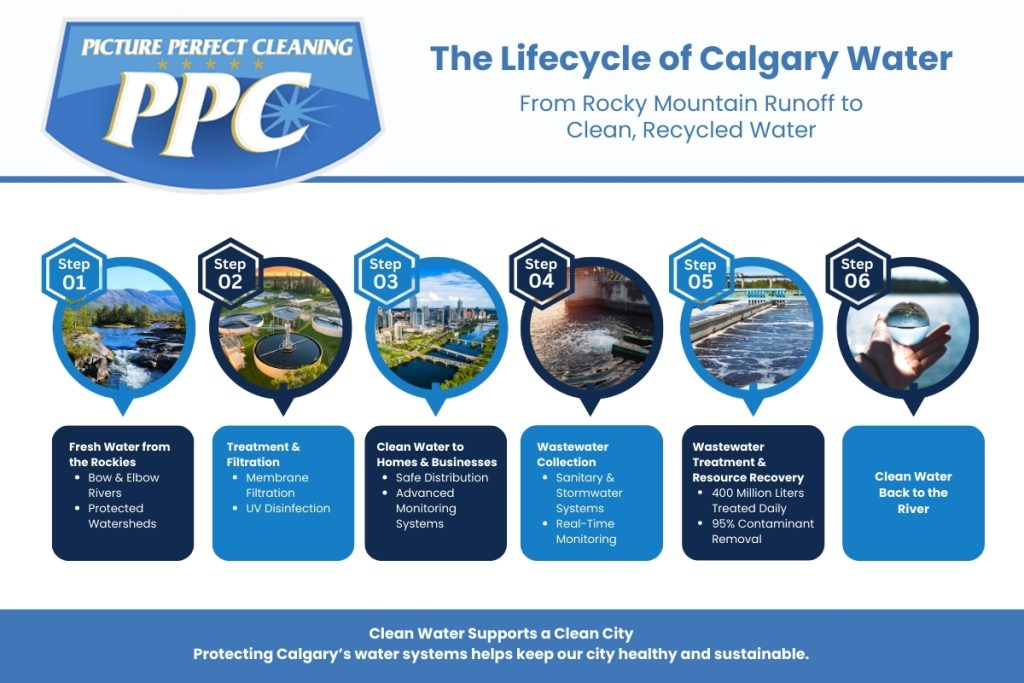
A city’s cleanliness is often shaped by systems people rarely see. Calgary’s wastewater management one such system, and is widely recognized for its efficiency and environmental protection standards.
The city operates three major wastewater treatment facilities: Bonnybrook, Fish Creek, and Pine Creek. Together, these plants process more than 400 million litres of wastewater each day while also recovering usable resources during treatment.
Here are a few fast facts:
- Treatment often exceeds provincial and federal requirements before water is discharged back into rivers.
- These facilities remove over 95% of organic matter, nutrients, and contaminants, protecting downstream ecosystems.
- Calgary treats a higher percentage of stormwater than many cities treat sanitary water.
- The city utilizes separate storm and sanitary sewer systems, stormwater retention ponds, bioswales, and permeable pavement.
- Heavy investment in pipe replacement and real-time monitoring helps prevent system failures and meet the needs of a growing population.
3. Optimized Traffic Flow and Reduced Emissions

Image via Wikipedia from user Zeekakboos
As we all know, air quality and cleanliness are inextricably linked to how a city moves. Calgary’s “Go Plan” and integrated transportation strategies focus on minimizing idling and congestion.
Did you know:
- Calgary’s CTrain system was the first light rail network in North America powered entirely by wind-generated electricity. This renewable energy approach supports lower transportation emissions while helping move thousands of commuters each day without adding more vehicles to the road.
- The city’s grid-style road layout and synchronized traffic lights help reduce stop-and-go driving. When vehicles spend less time idling, emissions drop and streets stay noticeably cleaner than in many larger urban centers.
- Calgary also makes strong use of dedicated bus lanes and carpool routes. Prioritizing high-occupancy vehicles helps shorten commute times and reduces the number of single-driver vehicles contributing to congestion.
- Active transportation plays a major role as well. Calgary maintains more than 1,000 kilometres of bike paths throughout the city, giving residents and visitors alike a practical alternative to driving while supporting healthier and lower-emission commuting.
- Downtown Calgary is designed to be pedestrian-friendly, with walkable streets and accessible public spaces. Reducing reliance on vehicles in dense areas helps limit pollution buildup and contributes to a cleaner and more comfortable city core.
4. Comprehensive Waste and Recycling Programs
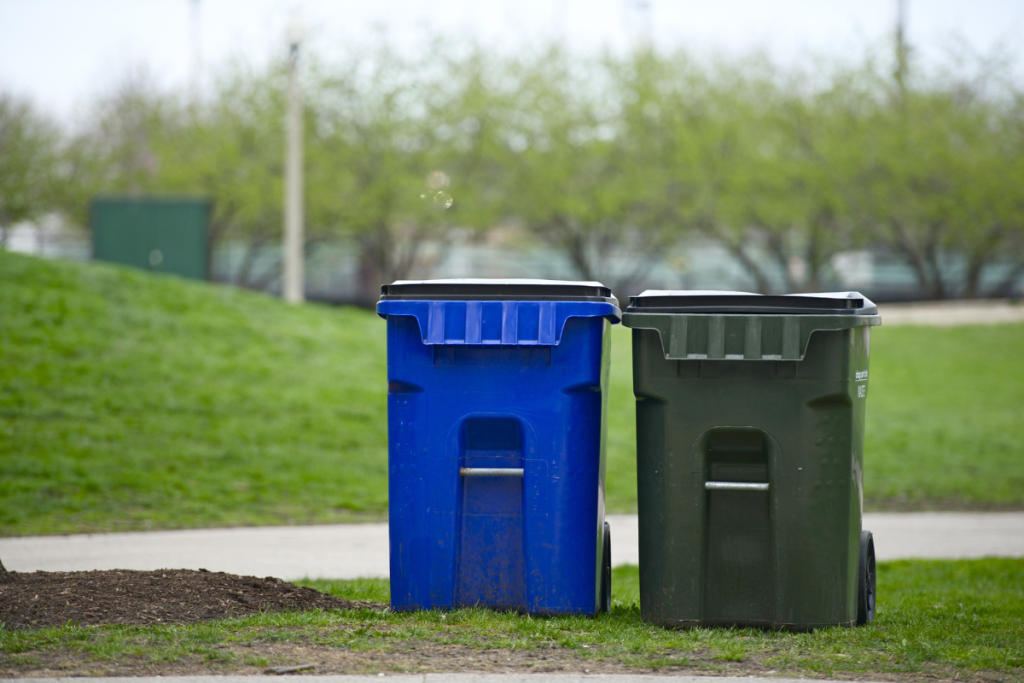
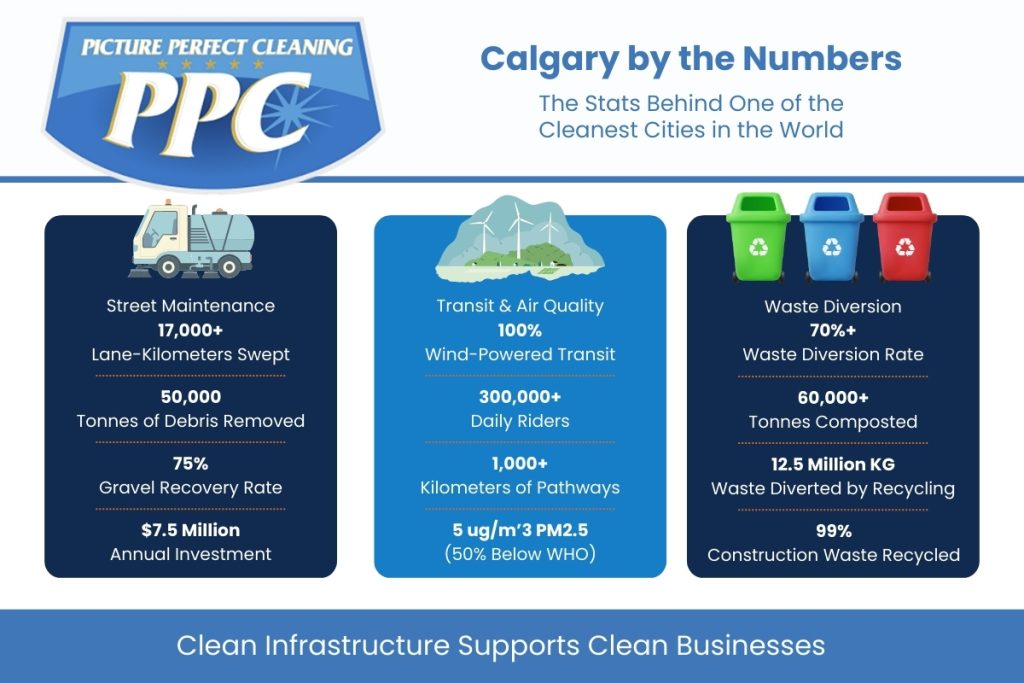
Calgary’s waste management system is among the most advanced in North America, achieving waste diversion rates that exceed 70%, well above the national average.
The Three-Cart System
The city’s blue, green, and black cart program makes recycling and composting easy and accessible for everyone:
- Blue Cart (Recycling): Paper, cardboard, plastics, metals, and glass
- Green Cart (Composting): Food waste, yard waste, and compostable materials
- Black Cart (Landfill): Non-recyclable, non-compostable waste only
Organic Waste Processing
The city’s composting program diverts over 60,000 tonnes of organic waste from landfills every year. This material is processed into nutrient-rich compost that is then used in parks, gardens, and landscaping projects throughout Calgary, creating a closed-loop system that reduces waste while enriching soil.
5. Impeccably Maintained Streets and Public Spaces
One of the most immediate things visitors to our beautiful city notice is the condition of the pavement. Calgary invests heavily in its annual “Spring Clean-up” program.
Once the snow melts, high-efficiency street sweepers hit the roads to remove over 30,000 tonnes of sand and salt left behind from the winter. This prevents dust from entering the air and debris from clogging the storm drains.
The Spring Clean-up program employs:
- A fleet of specialized street sweepers and cleaning equipment
- Coordinated scheduling that minimizes traffic disruption
- Public communication systems to notify residents of cleaning schedules
- Environmentally responsible disposal of collected materials
What’s more, the parks department maintains over 8,000 hectares of parkland and 1,000 kilometers of pathways that make the entire city feel like a well-kept garden.
Anti-Littering Enforcement and Education
Calgary enforces strict anti-littering bylaws with fines up to $1,000 for violations. However, the city’s success stems primarily from education and civic pride, not from enforcement alone. Community cleanup events, school programs, and public awareness campaigns encourage residents to take ownership of their city’s cleanliness.
The result is a city where clean streets and public spaces are the norm, contributing to Calgary’s reputation as one of the world’s most beautiful and livable urban centers.
6. Exceptional Air Quality and Low Pollution Levels

Calgary is famous for its “Blue Sky City” branding, and it isn’t just marketing. The city ranks among the best major cities for air quality worldwide.
Calgary’s air quality indices tell a compelling story:
- PM2.5 levels: Average annual concentration of approximately 5 μg/m³, well below WHO guidelines of 10 μg/m³.
- Air Quality Index (AQI): Typically ranges between 30-40, consistently rated as ‘good.’
- Annual ‘good’ air quality days: Over 90% of days meet or exceed air quality standards.
The combination of high altitude, the “Chinook” winds that sweep the air clean, and a lack of heavy polluting industry within city limits ensures that the air is crisp and clear. This lack of airborne pollutants means that buildings stay cleaner longer, and the overall “feel” of the city remains fresh and vibrant.
How Picture Perfect Cleaning Contributes to Calgary’s Legacy
A clean city is a collective effort. While the municipal government handles the streets and the sewers, the internal health of the city’s businesses rests on us.
At Picture Perfect Cleaning, we believe that the “cleanest city in the world” deserves the cleanest offices, medical facilities, and schools in the world. We contribute to Calgary’s gold standard by using eco-friendly solutions and green cleaning products that don’t contribute to water or air pollution. Our health-first protocols ensure that high-traffic commercial spaces are meticulously sanitized to prevent the spread of illness, directly supporting the city’s reputation for health and wellness.
By supporting local businesses, we ensure the whole city shines. If you’d like Picture Perfect Cleaning to help your business contribute to Calgary’s cleanliness legacy, contact us for a free quote today.